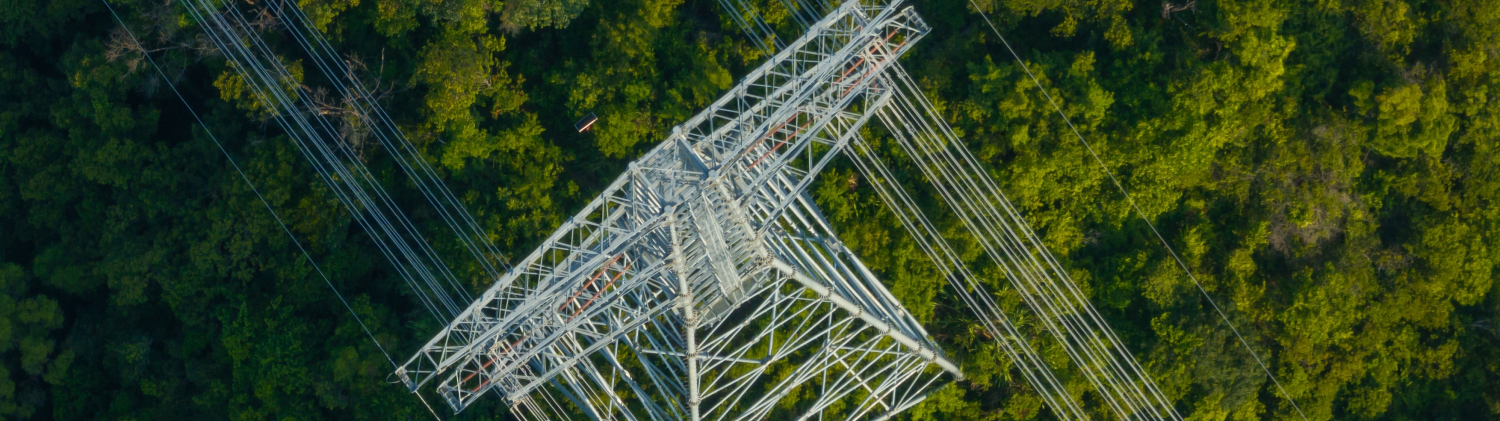
TL;DR: Weather-related outages from vegetation cost utilities billions each year because fixed inspection schedules and reactive trimming miss high-risk spans and waste budget. Modern programs like TreeRisk use high-resolution aerial imagery, 3D point clouds, and span-level risk scoring to focus crews on the spans most likely to fail, adjusting trim cycles to measured growth with a measurable ROI.
Utility vegetation management combines aerial surveys, predictive analytics, and risk-based prioritization to prevent outages. Traditional vegetation management trims every span on fixed three-year cycles regardless of actual risk. Fast-growing cottonwoods get the same attention as slow-growing oaks. High-wind corridors receive no priority over protected valleys. Aerial surveys combined with predictive analytics identify which spans will fail before they cause outages. Crews work high-probability failures first. Trim cycles adjust to measured growth rates instead of arbitrary schedules.
Modern vegetation management programs use high-resolution imagery to measure clearances, calculate species-specific growth rates, and assign risk scores to individual spans. Crews work on high-probability failures instead of patrolling sequentially. The result: fewer outages, lower costs, and data-driven compliance documentation.
This guide covers aerial imagery, LiDAR, growth modeling, and span-level risk analytics. You'll learn how to identify encroachment before outages and quantify your ROI.
Modern Technology Solutions for Utility Vegetation Risk Management
Electrical grids now operate under conditions their designers never anticipated. Demand peaks jumped 40 to 60% over the past decade in many regions. Distributed energy resources created bidirectional power flows. Extreme weather events hit harder and more often. Vegetation management shifted from maintenance to infrastructure protection.
One vegetation contact cascades into regional blackouts. The August 2003 Northeast blackout started when an untrimmed tree in Ohio contacted a 345 kV transmission line. That single contact cascaded into a regional failure affecting 50 million people across eight states and costing $6 billion. Grid interconnection turns localized vegetation failures into system-wide events because automatic protection systems trip adjacent lines to prevent equipment damage, shifting load onto already-stressed circuits.
Federal Energy Regulatory Commission standards require documented inspection programs and corrective action tracking. State regulators review vegetation management effectiveness during rate cases. California holds utilities liable for wildfire ignition in high-risk areas. Penalties reach billions.
Hundreds of millions in grid modernization deliver limited returns if trees keep causing outages. The business case for advanced grid technologies requires proven vegetation risk mitigation.
Equipment failures get customer understanding because transformers and breakers fail unpredictably. Tree outages don't. Customers see untrimmed branches and assume incompetence. Public service commissioners ask why utilities didn't prevent predictable failures during rate case hearings.
Utilities demonstrating proactive risk mitigation through aerial imagery secure better insurance terms.
Modern Technology Solutions for Utility Vegetation Management
How aerial surveys work
Aerial imagery surveys entire service territories in days, not months. Eagleview captures imagery at 70 times the resolution of standard satellite data. Vegetation managers identify individual tree species, measure branch diameters, and assess tree health across thousands of circuit miles.
Aerial surveys eliminate geographic and time constraints. One survey captures complete corridor conditions regardless of terrain or access. The imagery generates 3D point cloud models that calculate clearances between vegetation and conductors across every span.
Ryan Blothenburg manages 2,800 circuit miles for National Grid's western New York division. His team surveys 350 corridor miles annually with aerial imagery. They eliminated routine helicopter surveys except where TreeRisk flags problems. Field crews work from prioritized lists with exact locations instead of sequential patrols.
TreeRisk data testing showed less than 1% false positives across National Grid's 350-mile corridor. Crews address actual encroachment risks instead of investigating clean spans.
Crews cross-check field measurements against aerial data to verify assessments and document work.
How TreeRisk monitors and analyzes vegetation risk
TreeRisk extracts 3D point cloud data from aerial imagery to identify vegetation encroachments and high-risk locations. The platform processes orthogonal and oblique imagery to create three-dimensional corridor models.
The 3D point cloud measures clearances with precision, matching ground-based tools. Traditional LiDAR captures structure but limited color information. TreeRisk generates color-rich 3D models at a lower cost. Vegetation managers identify tree species, assess health conditions, and measure growth over time.
Some utilities use LiDAR for transmission surveys where sub-centimeter elevation accuracy matters for conductor sag calculations. They use TreeRisk for vegetation identification and risk scoring. TreeRisk delivers vegetation-specific analysis at a fraction of LiDAR costs.
Growth models analyze multi-year imagery to calculate how fast specific trees grow toward conductors. Cottonwoods add 3 to 5 feet annually. Oaks add 8 to 14 inches. Slope changes growth direction. South-facing spans get more sun exposure and faster growth. The system learns these patterns and projects when each span will violate clearance requirements.
Span-level risk scoring combines multiple factors into one prioritization metric. The algorithm considers current clearance, tree height relative to conductors, species growth characteristics, terrain slope, wind exposure, soil conditions, and historical outages. Risk scores update automatically with new imagery or completed work documentation.
GIS integration streamlines utility adoption
TreeRisk connects with existing GIS systems and regulatory reporting. Data formats match utility workflows.
Crews load MapBooks onto tablets showing exact problem locations with pole numbers and coordinates. They verify conditions, trim flagged trees, and photograph completed work. Documentation feeds back to update risk scores and track which predictions proved accurate.
Data-Driven Optimization for Utility Vegetation Management
Historical growth tracking improves trim cycles
Best practice vegetation management tracks actual growth patterns instead of assuming uniform rates. TreeRisk analyzes multi-year imagery to calculate growth trajectories for specific spans and vegetation types.
Utilities know 18 months in advance which regions need heavy trimming and which need light maintenance. Labor planning improves. Contractor negotiations use actual work volume data.
These considerations drive accurate growth forecasting:
- Climate variability makes historical tracking essential. Growing seasons now extend by days or weeks in many regions compared to historical averages. Historical growth data captures these changes and adjusts predictions accordingly.
- Growth pattern analysis also catches anomalies. If a span shows growth rates significantly above species averages, the system flags it for investigation. Sometimes this reveals drainage changes, root damage, or stress conditions that accelerate growth.
- Savings are achieved by eliminating unnecessary early trimming in slow-growth areas while preventing emergency work in fast-growth areas. The approach optimizes trim timing to meet actual needs rather than adhering to fixed schedules.
Span-level risk scoring improves visibility and prioritization
Vegetation managers need to know which of their 50,000 spans will fail first. TreeRisk scores every span by combining clearance distance, tree height, species growth rate, terrain slope, wind exposure, and outage history. Scores update with each survey. High scores trigger work orders. Medium scores enter monitoring queues. Low scores stay on standard cycles.
| Factor | What It Measures | Impact on Risk Score |
| Current clearance | Distance between vegetation and conductors | Low clearance increases the score immediately |
| Tree height | Potential fall-in distance and strike zone | Taller trees with reach toward conductors raise the risk |
| Species growth rate | How quickly branches regrow after trimming | Fast-growing species accelerate score progression |
| Terrain slope | Likelihood of tree lean or root instability | Steep slopes increase fall potential |
| Wind exposure | Local wind patterns and gust history | High-wind corridors increase strike risk |
| Soil conditions | Soil type, moisture, and root support | Weak or saturated soils raise fall likelihood |
| Historical outage data | Past vegetation-caused interruptions | Prior events raise baseline risk |
| Span importance | Critical loads, hospitals, substations, wildfire zones | Higher criticality raises monitoring priority |
Risk scoring transforms work order prioritization from reactive to analytical. Vegetation managers address spans most likely to fail instead of responding to recent outages:
- High-risk spans get immediate attention
- Medium-risk spans enter the work queue
- Low-risk spans get monitored without consuming field resources unnecessarily.
Crews finish 25% more work per day because they drive directly to flagged spans instead of patrolling miles of clean corridor looking for problems.
A transmission line tripped twice in one week across a 20-span section. National Grid pulled TreeRisk data, identified the only span with vegetation risk, and dispatched a crew in 20 minutes. They ruled out vegetation and identified the actual cause: a failing insulator. Without risk scoring, crews would have patrolled all 20 spans searching for tree contact.
Risk scoring strengthens regulatory relationships. Utilities demonstrate risk-based decision-making with data showing why specific spans received attention and others didn't.
TreeRisk overlays risk scores onto utility GIS maps. Vegetation managers see which high-risk spans feed hospitals, substations, or dense customer areas. Critical infrastructure spans get priority. Wildfire zones receive enhanced monitoring during fire season.
Implementing Utility Vegetation Management Best Practices
Building the ROI business case
Calculate ROI by comparing current program costs against projected costs with aerial imagery and predictive analytics. Start with baseline spending: labor, equipment, contractors, and overhead. Add outage costs attributable to vegetation from historical data. Include regulatory compliance costs and penalty risk for inadequate vegetation management.
For project costs with aerial implementation, include imagery surveys, platform licenses, training, and integration work. Estimate savings from reduced field time, optimized trim schedules, and avoided emergency work. Factor in reliability improvements and their value to customer satisfaction and regulatory standing.
A potential scenario
A mid-sized utility manages 5,000 circuit miles with a $25 million annual vegetation budget. Fixed three-year trim cycles treat every span identically regardless of actual risk. Annual helicopter surveys cost $75,000. Ground patrols consume 15,000 labor hours. Emergency callouts for vegetation-caused outages average 18 per year at $45,000 each in restoration costs.
After implementing aerial imagery and predictive analytics, 30% of spans safely extend to four or five-year cycles based on slow growth rates and low-risk positioning. Another 15% require accelerated 18 to 24-month cycles due to fast-growing species or high wind exposure. The remaining 55% stay on modified three-year schedules with trim timing based on actual growth data.
Year one results: helicopter survey costs drop to $20,000 for targeted problem-area flights. Ground patrol hours decrease 40% as crews work from prioritized lists instead of sequential routes. Emergency callouts fall from 18 to 11 as predictive models catch encroachments before contact.
By year three, the utility reduced total program spending by $4.2 million annually. Vegetation-caused outages dropped to six per year. Crews complete 25% more planned work orders per field day because they arrive at specific problem trees instead of surveying entire corridors. Regulatory audits receive documented risk-based prioritization data instead of activity logs showing miles patrolled.
The $4.2 million in direct savings excludes avoided outage costs, reduced customer complaints, improved insurance terms, and regulatory goodwill from risk-based decision making.
Total program ROI exceeds 200% within 36 months.
Implementation planning and timelines
Start with transmission corridors where outages affect more customers and draw higher regulatory scrutiny. Add distribution systems after validating processes.
Most utilities schedule annual aerial surveys with supplemental flights for high-risk areas after major weather events. Late-season surveys capture maximum growth. Early-season surveys establish baselines. Data processing takes four to six weeks.
Run parallel systems for six to 12 months. Continue existing patrols while validating aerial predictions. Field crews measure actual clearances and compare them against TreeRisk data. Risk models tune to local conditions. Most utilities gain confidence after one growing season when predictions match field observations.
Office staff need a few hours to learn the platform interface and risk scoring methodology. Field crews need MapBook orientation. Most utilities complete initial training within two to four weeks.
Best practices for program success
First-year surveys reveal spans that never made it onto patrol routes. Trees growing on private property outside easements. Fast-growing volunteers between scheduled trim cycles. Spans obscured by terrain that ground crews couldn't see. These risks existed all along. Aerial surveys make them visible and addressable.
Track program performance with consistent metrics: vegetation-caused outages per 100 circuit miles, average clearances across risk categories, cost per mile managed, and work orders completed per field day. These metrics justify continued investment and satisfy regulatory audits.
Expected results and outcomes
Results appear within 18 to 24 months. Vegetation-caused outages drop 30 to 40% as crews address high-probability failures before contact. Emergency callouts decline because predictive models catch encroachments during scheduled work instead of after outages.
Crew productivity increases when field teams work from prioritized lists with precise locations. Budget planning improves with 18-month advance visibility into work requirements. Most utilities expand usage over time, adding distribution circuits after transmission corridors validate the approach.
Optimize Your Utility Vegetation Management Program With Eagleview
Aerial imagery and predictive analytics transform vegetation management into data-driven risk mitigation. TreeRisk risk scoring prioritizes spans most likely to cause outages based on clearance distance, growth characteristics, terrain, and historical patterns. Crews work on hazards instead of patrolling to find them.
The platform integrates with existing GIS systems and work order management through standard shapefile exports and API access.
Ready to see how TreeRisk operates?
Get in touch with Eagleview to schedule a consultation and quantify your team's ROI across your service territory.
FAQ
How does TreeRisk handle seasonal variation in deciduous versus coniferous coverage?
TreeRisk processes both leaf-on and leaf-off imagery to account for seasonal canopy changes. Deciduous trees receive growth projections based on species-specific leaf emergence and senescence patterns. Coniferous coverage uses year-round growth data with adjustments for dormant periods. The system flags spans where deciduous canopy conceals underlying encroachment risks during leaf-off surveys. Utilities in mixed-forest regions typically schedule one leaf-off survey in late winter to assess structural encroachment and one leaf-on survey in late summer to capture maximum growth conditions.
How does TreeRisk assess wildfire ignition risk in high-threat zones?
TreeRisk flags spans in designated wildfire zones by measuring clearance, identifying high-flammability species (eucalyptus, pine, dry brush), and analyzing terrain for fire spread potential. The platform flags spans in designated fire areas for enhanced monitoring during dry seasons. It weights species by ignition temperature, moisture content, and volatile oil concentration. Eucalyptus and pine receive higher flammability scores than oak or maple. Terrain analysis accounts for fire spread vectors and updraft patterns on steep slopes. The system integrates with state and federal wildfire hazard maps to apply enhanced scrutiny in high-risk zones. Documentation shows proactive mitigation for regulatory compliance and insurance underwriting.
What's the minimum circuit density where TreeRisk becomes cost-effective versus manual inspection?
TreeRisk becomes cost-effective at approximately 500 circuit miles or 1,200 spans for most utilities. Below this threshold, manual inspection overhead may match or exceed aerial survey and platform costs. Cost-effectiveness improves with difficult terrain, limited road access, or high vegetation density where ground patrols consume excessive time. Utilities with high wildfire liability or frequent vegetation-caused outages see positive ROI at lower circuit densities due to avoided outage and litigation costs. Regional cooperatives serving 200 to 400 circuit miles share aerial survey costs across multiple utilities to reach cost-effectiveness thresholds.
How does TreeRisk validate growth predictions in microclimates with high variability?
TreeRisk validates growth predictions using localized weather data from NOAA stations, soil moisture sensors, and elevation-adjusted temperature models. The system segments service territories into microclimate zones based on aspect, elevation, proximity to water bodies, and urban heat island effects. Growth models recalibrate quarterly using field crew measurements to correct for unexpected microclimate variations. Spans showing growth rates exceeding model predictions by more than 15% trigger investigation for drainage changes, root damage, or measurement errors. Coastal utilities see different growth patterns than inland territories at the same latitude due to marine layer influence on temperature and moisture.
What integration requirements does TreeRisk have for existing GIS and work management systems?
TreeRisk exports data in standard shapefile format for import into Esri ArcGIS, QGIS, and other GIS platforms. Work order systems receive span-level risk data through CSV exports or REST API calls. The platform supports custom field mapping to match utility-specific pole numbering conventions, circuit naming schemes, and asset hierarchies. Most utilities complete GIS integration within two to four weeks using existing IT resources. API documentation includes sample scripts for automated daily exports to work management systems like Oracle Utilities, SAP, and Maximo.
How does TreeRisk measure clearance accuracy in spans with multiple conductor heights?
TreeRisk calculates clearances for each conductor individually using 3D point cloud data that captures vertical separation between vegetation and every wire. Transmission spans with multiple voltage levels receive separate clearance measurements for each conductor tier. Distribution spans with primary and secondary lines get individual clearance calculations. The system applies voltage-specific minimum clearance requirements based on NESC standards and utility-specific policies. Spans violating clearance requirements on any conductor receive high-risk flags even if other conductors maintain adequate clearance.
What's the typical implementation timeline for utility vegetation management technology?
Implementation runs six to 12 months from initial survey to full operation. Aerial surveys take days to weeks depending on territory size. Data processing requires four to six weeks. Validation against field observations and risk model tuning takes several months. Most utilities run parallel systems initially, continuing some manual patrols while building confidence in aerial predictions. Full program transition completes within one growing season. Utilities starting implementation in spring see full operational capability by the following spring after capturing one complete growth cycle.
How often should utilities schedule aerial surveys for vegetation management?
Most utilities schedule annual surveys to track vegetation growth across the full growing season. High-risk areas or regions with fast-growing species benefit from twice-yearly surveys. Areas with slower growth and lower risk sometimes extend to 18-month intervals. Survey frequency matches specific conditions, regulatory requirements, and risk tolerance. Utilities in wildfire zones conduct additional surveys after prolonged drought or high-wind events that increase branch breakage and fall-in risk. Late-season surveys in August or September capture peak vegetation growth before fall dormancy.
How does TreeRisk account for underground utility corridors and rights-of-way restrictions?
TreeRisk overlays property boundary data and easement information from utility GIS systems to identify rights-of-way restrictions. The platform flags vegetation growing on private property outside utility easements that threatens overhead lines. Landowner contact information integrates with work order generation for spans requiring permission before trimming. The system tracks notification timelines and regulatory requirements for vegetation work on private property. Utilities use this data to prioritize spans where easements allow immediate trimming while managing communication timelines for restricted-access spans.
What vegetation species identification accuracy does TreeRisk achieve with aerial imagery?
TreeRisk identifies tree species with approximately 85 to 90% accuracy using color-rich aerial imagery and machine learning models trained on regional tree databases. Identification accuracy varies by region and season. Leaf-on surveys in deciduous forests achieve higher accuracy than leaf-off surveys. The system distinguishes fast-growing species like cottonwood, willow, and poplar from slower-growing oak, maple, and hickory with high confidence. Misidentifications typically occur between similar species in the same genus rather than between fast and slow-growing categories. Field crews verify species identification during trimming operations and corrections feed back into the machine learning model.
How does TreeRisk prioritize spans in areas with both overhead and underground distribution?
TreeRisk focuses on overhead line corridors where vegetation contact causes outages. Underground distribution segments receive minimal attention unless overhead laterals or service drops connect to underground mains. The platform uses utility infrastructure data to distinguish overhead from underground segments. Risk scoring applies only to overhead spans. Utilities with mixed overhead-underground systems see crew efficiency gains by eliminating time spent inspecting underground segments where vegetation poses no outage risk.